
A pergola is not a piece of furniture:
It is a structure that is constantly exposed to wind, rain, humidity, and UV rays. Your project must be built to last. This is first and foremost an engineering issue.
Wood is selected based on two independent criteria: its durability against biological factors (water, fungi, insects) and its structural strength against loads (wind, snow, dead weight).
The right wood for every project

Durability: the service class
The service class (NF EN 335 standard) defines the level of moisture exposure that wood can withstand over time. For a pergola—an open structure that is exposed to rain, splashes, and moisture cycles—two types of wood are used in most projects:
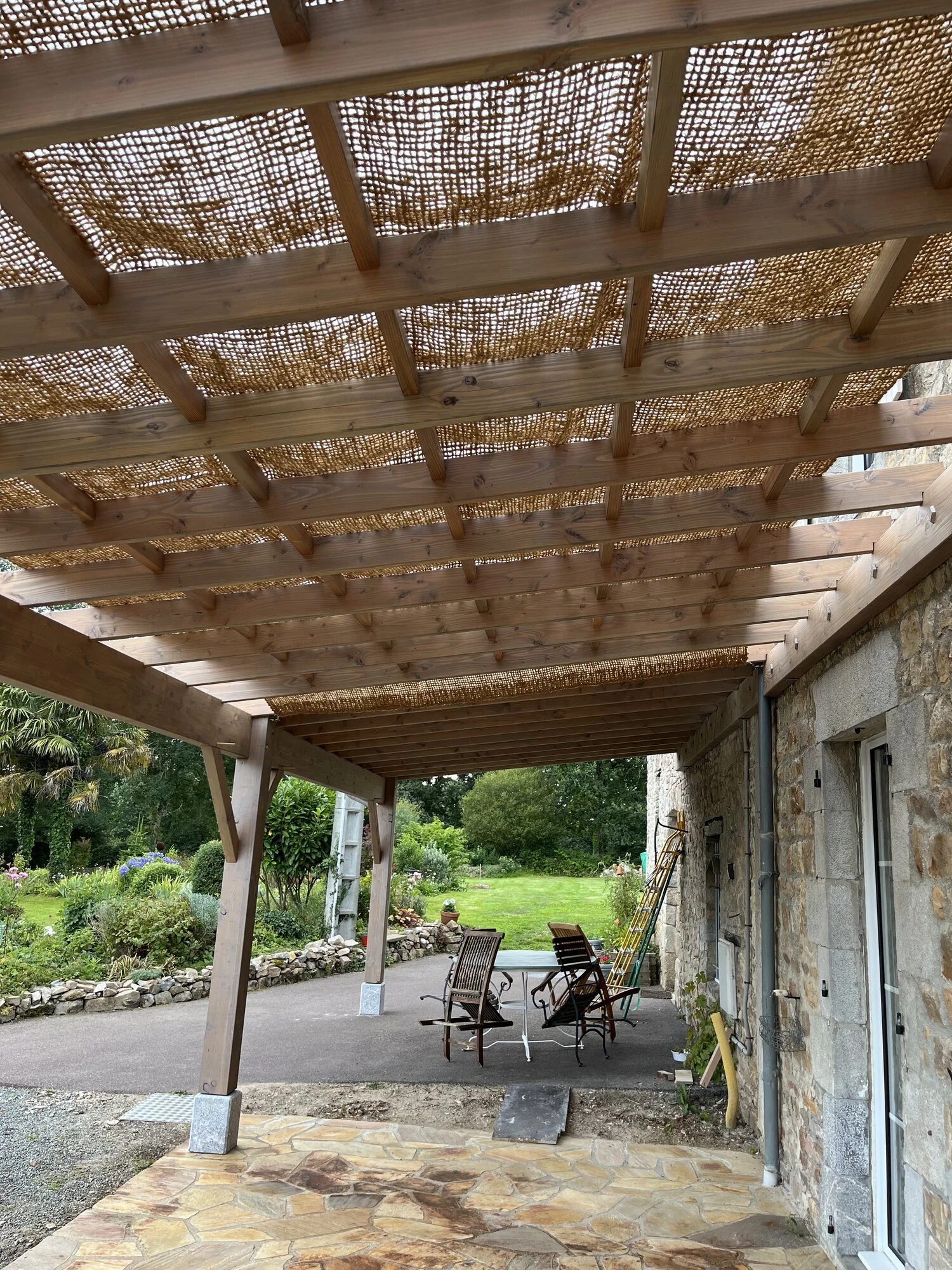
Douglas fir, durability class 3.2 — high natural durability. The heartwood of Douglas fir is naturally resistant to frequent moisture exposure. No chemical treatment is necessary; the wood retains its natural appearance and gradually weathers to a grayish tone. However, applying one or two coats of wood sealer will help preserve the wood’s natural color. Reapply every 2–3 years.
Autoclave-treated Scots pine, use class 4 — pressure-treated. Suitable for areas subject to heavy exposure: water splashes, prolonged ambient humidity, and immediate proximity to a stone patio. The benchmark for long-term durability.
These classifications are a guarantee of safety, not marketing gimmicks. An under-rated pergola deteriorates silently before the problem becomes visible.
A wooden structure built using our plans and following our recommendations can last 50 years!
Structural strength:
C24 or GL24h glued laminated timber
Regardless of the type of wood, it is tested for its ability to bear loads without breaking or bending.
Solid Douglas fir C24 — A softwood species grown in France, naturally durable (sapwood removed). Suitable for exposed structures such as pergolas. Use class 3.2, meaning frequent/prolonged moisture exposure. Exposed horizontal or sloped wood members. Avoid: areas prone to water retention, joints that trap moisture. Treating with a wood preservative every 2–3 years will increase durability. Otherwise, it will naturally turn gray. Class C24 is a generic class used for structural calculations. Also available in C18 and C30; C24 is the most common. If C24 is pressure-treated to Class 4, no additional treatment is necessary.
GL24h glued laminated timber — laminated under pressure, offering uniformity, minimal warping, and high strength. Ideal for long spans and exposed self-supporting structures. More expensive than C24, it is harder to find in Class 4. Otherwise, treat with a saturator every 2–3 years. Over time, small cracks may appear, but no long, significant cracks; generally no knots.


glued laminated timber
What the app does
The app helps you choose between the two. You remain in control: you select the wood species and configuration that suit your needs. Based on your project’s parameters—particularly the span—the app simply recommends the most suitable structural solution: C24 solid wood for controlled spans, or a hybrid solution combining GL24h glued-laminated timber (beams and columns) and C24 (joists) for spans exceeding 5 m.
The final decision is yours.→ For details on the calculations and verifications, see the page "Design Office · Eurocode 5."
